
Identify and save
historically significant places

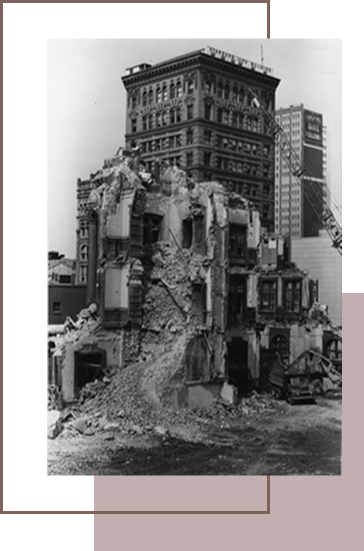
Preserving Pittsburgh’s Soul
Founded in 1964, the Pittsburgh History & Landmarks Foundation (PHLF) was created by citizens who believed that preserving historic places—rather than demolishing them—could renew communities, foster local pride, and drive sustainable economic growth. At the time, Pittsburgh—like many U.S. cities—was undergoing widespread “urban renewal,” replacing historic neighborhoods with generic buildings, parking lots, and highways. As Mayor David L. Lawrence famously said, “The town has no worship of landmarks. Instead, it takes pleasure in the swing of the headache ball and the crash of falling brick.”
In response, PHLF helped shift the city’s approach. It collaborated with the Department of Planning to draft Pittsburgh’s historic preservation ordinance, adopted in 1971, and led early studies of neighborhoods such as Manchester, laying the groundwork for a more balanced vision of urban development.
Today, recognized nationally as a leader in historic preservation, PHLF works to identify and save significant landmarks, revitalize neighborhoods and landscapes, and educate the public about Pittsburgh’s architectural heritage. While its primary focus remains the Pittsburgh area, the organization is chartered to serve communities within a 250-mile radius, extending its influence across the region.
Recognized nationally as one of the most innovative and effective nonprofit preservation organizations, PHLF works to:
historically significant places
historic neighborhoods, towns, and urban areas
historic farms and designed landscapes
the public about Pittsburgh’s rich architectural heritage
PHLF is supported by more than 2,000 members, and guided by 25 trustees, with 23 staff members and more than 75 volunteers.
Pennsylvania Avenue
Manchester
Two badly deteriorated three-story red brick townhouses in the Manchester Historic District fully restored into quality subsidized housing.
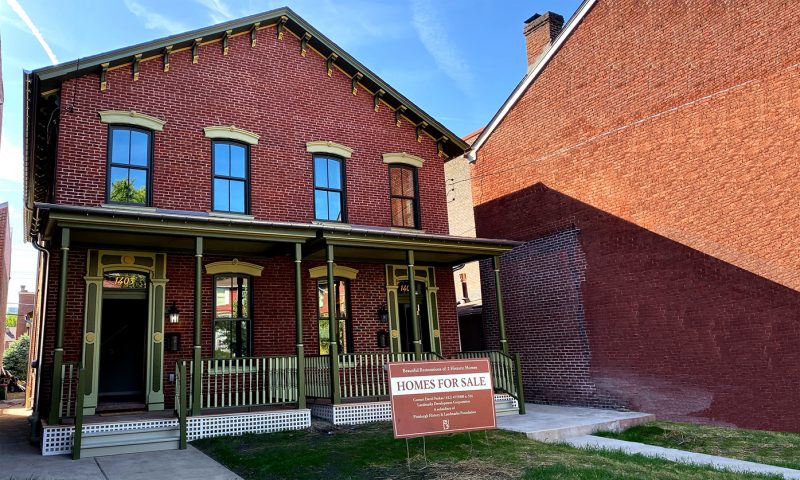
Pennsylvania Avenue
Manchester
Langenheim House
Manchester
One of Manchester's oldest surviving structures and the starting point for PHLF's founding mission, restored for apartment use.
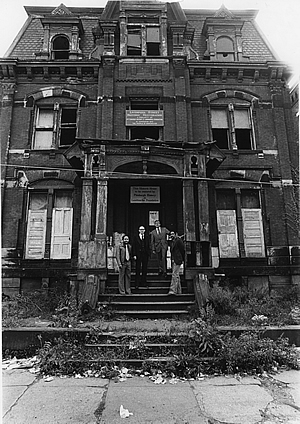
Langenheim House
Manchester
Market-at-Fifth
Downtown
Three historic buildings dating to the 1870s rescued from demolition and restored into a LEED Gold certified mixed-use development in the heart of Downtown Pittsburgh.

Market-at-Fifth
Downtown
Station Square
Downtown
PHLF's most ambitious historic preservation project, transforming a collection of underutilized Pittsburgh & Lake Erie Railroad buildings into a thriving riverfront destination.

Station Square
Downtown
Falconhurst Apartments
Wilkinsburg
A massive historic apartment building vacant for over 15 years, restored as part of an $11.5 million affordable housing initiative in Wilkinsburg.

Falconhurst Apartments
Wilkinsburg
Crescent Apartments
Wilkinsburg
A uniquely shaped 1904 apartment building restored from near collapse, now offering quality affordable housing in the Hamnett Place neighborhood.

Crescent Apartments
Wilkinsburg
About
PHLF operates through two subsidiaries that extend its impact:
A nonprofit lending arm that provides loans, grants, and investment capital to finance projects supporting the revitalization of urban centers, towns, and neighborhoods.
A for-profit real estate development company that offers consulting services and develops real estate aligned with PHLF’s preservation mission.